Traces left by previous owners and evaluation of used goods

How do visible traces of previous owners on products in secondary markets affect buyers’ evaluations? This is an interesting question for secondary markets like eBay, where thousands of used goods are sold and products start a second life after having being disposed by their initial owners. However, as many consumers tend to customize or personalize their products, this may leave on the products visible traces of the previous owners. How does that affect potential buyers’ evaluations of these goods? Jungkeun Kim (Auckland University of Technology, New Zealand) examined this question in several studies. He found that buyers evaluate used goods with salient traces of previous owners less positively because the salience of these traces makes it harder for potential buyers to psychologically appropriate the product and develop feelings of psychological ownership. Analyses of actual transactions from eBay.com also confirmed this effect. Apparently, making used goods ours presupposes forgetting that they used to be someone else’s; and erasing previous owners’ traces – even literally, e.g. with a cleaning service, as these studies show – may help overcome these psychological barriers that may prevent us from buying used goods.

You can read more about this research here.

One for you, one for me: Giving shared gifts

We know from past research on the mere ownership effect that people tend to like their possessions merely because they own them. But do people also like their possessions more merely because others own them too? Evan Polman (University of Wisconsin–Madison, USA) and Sam J. Maglio (University of Toronto Scarborough, Ontario, Canada) examined this question in the context of gift-giving. They found that when gift givers buy also for themselves what they gift, what the authors call “companionizing”, gift recipients like the gifts more and feel closer to the gift givers. These findings suggest that similarity due to owning the same item as someone else can increase liking of the item – and suggest a simple way to make gifts that are more satisfying!

You can read more about this research here.

Escaping the bonds of ownership with just a camera click

Parting with our possessions can be tough, especially when it comes to objects we are emotionally attached to. This is unfortunate not only because this would free us some space in our wardrobes and storage rooms, but most importantly because nonprofit organizations almost exclusively rely on donations, which means on consumers’ willingness to give away used goods. A new study by Karen Page Winterich (Pennsylvania State University, USA), Rebecca Walker Reczek (Ohio State University, USA) and Julie R. Irwin (University of Texas at Austin, USA) provides an imaginative solution to this problem. Taking a picture of a cherished possession increases donations because it helps consumers deal with the identity loss associated with giving away sentimental goods. The authors suggest that pictures facilitate decisions to donate because they help keep the memory and thus the emotional value of the object, even in the absence of the object itself. Taking a picture could then liberate us from being possessed by our possessions and do good to others at the same time.

You can read more about this research here.

Just owned – already ‘mine’?

Have you ever wondered how much time is required before we see owned objects as reflections of ourselves? It is known from prior research using various explicit measures such as favourability ratings that people tend to associate owned objects with the self. What is less known though is how long it takes for associations between owned objects and the self to emerge. A new study by A. Nicole LeBarr and Judith M. Shedden (McMaster University, Canada) distinguished between newly-owned and already-owned objects in order to provide an answer to this question with the help of implicit measures. According to the results of the study, people were fast at associating owned objects with themselves even if they had owned them just for a few minutes. Apparently, the time between owning a new object and viewing it as a reflection of ourselves might be much shorter than previously thought.

You can read more about this research here.

“The Future of Ownership Research” Workshop 2017

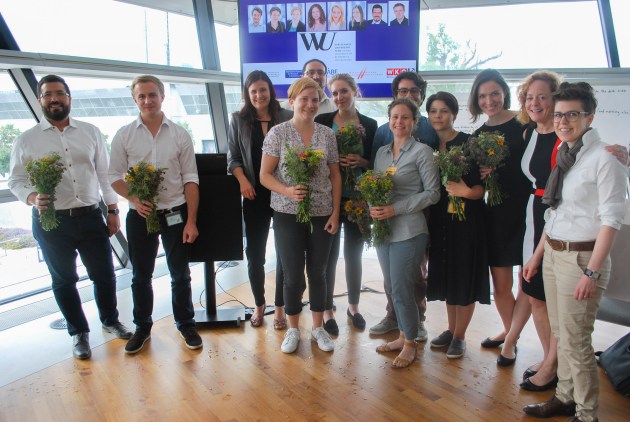
As already announced earlier this month, our team hosted an interdisciplinary workshop on ownership research at the WU Vienna University of Economics and Business in collaboration with our colleagues Joann Peck (University of Wisconsin-Madison) and Stephan Dickert (Queen Mary University of London).

Ownership_Workshop_2017_90

The Origanizational Committee

The workshop took place on July 7th and 8th and we are now happy to be able to share the highlights of this special get-together with you. You will find a detailled report by [CLICKING HERE]. Alternatively, you can also reach the page through the main navigation under the “events” tab.

We are still in the process of adding more material as we go so make sure to check back regularly for new insights on the future of ownership research.

“The Future of Ownership Research” – Workshop at WU Vienna

Dear readers,

as aleady announced earlier this year, we are hosting a workshop on ownership research titled “The Future of Ownership Research” at the Vienna University of Economics & Business (WU Vienna), which will take place this Friday and Saturday, July 7th + 8th.

TheScienceofOwnership.org will of course cover the workshop in more detail, so be prepared to read more about it soon.

Detailled information about the speakers and the program can be found [HERE].

We are looking forward to providing you with an update soon.

– The Science of Ownership Team


Owning our beliefs: Mental materialism and intellectual arrogance

Expanding concepts of materialism and territoriality from material objects to beliefs, new research by Aiden P. Gregg, Nikhila Mahadevan, and Constantine Sedikides (University of Southampton) suggests that people view their core beliefs as valued possessions and develop a sense of mental materialism towards them. As a consequence, people might react with a sense of ideological territoriality when they have to fight to protect their beliefs, which can lead to intellectual arrogance. The authors examine how differences in communion and agency predict whether people take a hostile epistemic stance (rejecting reality) or a deferential one (embracing reality).

You can read more about this research here.

Self-enhancement and other-derogation as explanations of the ownership effect

A novel look into ownership phenomena. People’s tendency to overvalue owned objects has been often explained through self-enhancement – viewing owned things in a more positive light. However, recent research by Yunhui Huang (Nanjing University, China) and Yin Wu (Shenzhen University and Peking University, China) proposes other-derogation as another potential explanation. According to this research, the higher value people place on self-possessions can also be explained by their tendency to view other-possessions less favorably. Other-derogation can be another underlying mechanism that explains the ownership effect besides self-enhancement.

You can read more about this research here.

The Future of Ownership Research – Workshop held on July 7-8 2017

If you find yourself reading this post, I am quite sure you know that ownership is a concept that is fundamentally linked to almost all transactions in our society. Every economical transaction also involves a transfer of ownership.

On this note, the Institute for Marketing & Consumer Research (m.core) from WU Vienna is hosting a small-scale workshop on (psychological) ownership that will be held on July 7th-8th, 2017. In addition to Bernadette Kamleitner and Monika Koller (m.core) we are happy to announce that Stephan Dickert (Queen Mary University of London) and Joan Peck (University of Wisconsin-Madison) will also be part of the organization committee.

Within the scope of the workshop, which is being held for the second time his year, we aim to bring together researchers with different disciplinary backgrounds to facilitate a fruitful discourse on the phenomenon, its variants, its antecedents and its consequences. The goal is to jointly move towards a much-needed unified theory of ownership and to shape the future of ownership research.

If the above description makes you feel like this workshop is also a bit yours (pun intended) then you should apply for one of our travel scholarships. They are available for early career scholars and PhD students.

To get more about the workshop visit our official homepage here [CLICK]

To get the details about how to apply for scholarships click here [CLICK] 

Personal Data and (Psychological) Ownership: A Book Chapter by Bernadette Kamleitner & Vince Mitchell

We are writing the year 2017, an era with a higher population of mobile gadgets than people (GSMA Intelligence 2017), where we easily create a 10 million Blu-ray discs amount of data each day (Walker 2015). A substantial fraction of these data represents virtual copies of our very selves. From digitally tracking our personal health over religiously using our loyalty cards for better deals to simply surfing the Internet for information – where we go, what we do and consume, how we behave and feel is not a private matter anymore (Haddadi & Brown 2014). Despite heightened public concern about how personal data is collected and used (Pew Research Center 2014), we rarely think about oversharing when we download apps, sign up for mailing lists, or give away our personal details in exchange for a boost in convenience and temporary well-being. What is more, the question of who holds legitimate claim over these data – legally as well as psychologically – is still fuelling an undisputed yet to date unsatisfactory debate.

In a new book chapter to appear in a book on ownership that Joann Peck and Suzanne Shu are editing for Springer, Bernadette Kamleitner from WU Vienna and Vince Mitchell who is just about to move from London to The University of Sydney are exploring these and related questions in detail and come to surprising conclusions about the logic of ownership in the context of personal data. Read for yourself what they discovered in the abstract below. The matching first-draft of the chapter in its entirety can be downloaded [HERE]:

In the age of information everything becomes mined for the nuggets giving rise to it: data. Yet, who these new treasures do and should belong to is still being hotly debated. With individuals often acting as the source of the ore and businesses acting as the miners, both appear to hold a claim. This chapter contributes to this debate by analyzing whether and when personal data may evoke a sense of ownership in those they are about. Juxtaposing insights on the experience and functions of ownership with the essence of data and practices in data markets, we conclude that a very large fraction of personal data defies the logic and mechanisms of psychological possessions. In the canon of reasons for this defeat, issues of data characteristics, obscuring market practices, and data’s mere scope are center stage. In response, we propose to condense the boundless collection of data points into the singularized and graspable metaphor of a digital blueprint of the self. This metaphor is suggested to grasp the notion of personal data. To also enable consumers to effectively manage their data, we advocate adopting a practice commonly used with plentiful assets: the establishment of personal data agents and managers.

References

GSMA Intelligence. (2017), available at https://www.gsmaintelligence.com/

Haddadi & Brown (2014), Quantified Self and the Privacy Challenge, Technology Law Futures.

Kamleitner & Mitchell (2017). Can consumers experience ownership for all their personal data? From issues of scope and invisibility agents handling our digital footpring. In press

Pew Research Center (2014). Public Perceptions of Privacy and Security in the Post-Snowden Era. November 12. http://www.pewresearch.org.

Walker (2015). Every Day Big Data Statistics – 2.5 Quintillion Bytes of Data Created Daily. Available at http://www.vcloudnews.com/every-day-big-data-statistics-2-5-quintillion-bytes-of-data-created-daily/